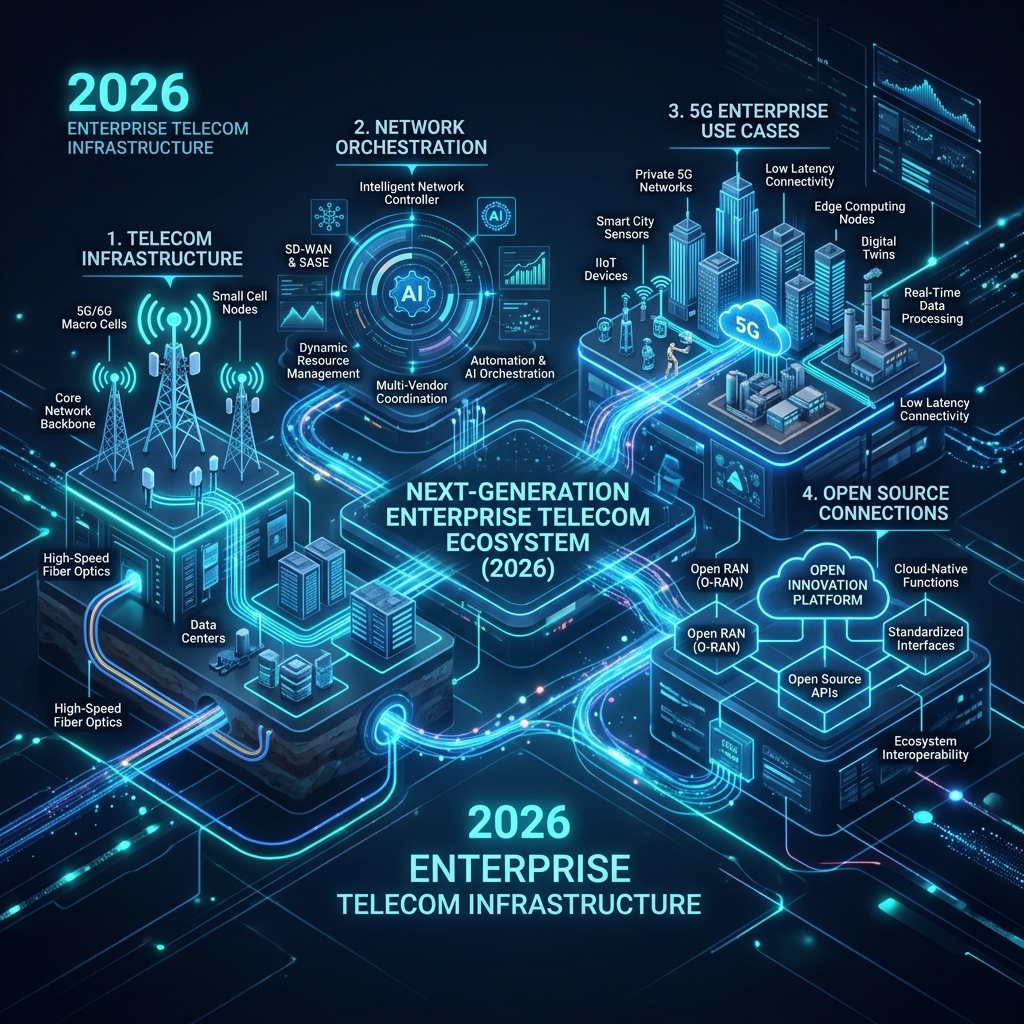
Telecom: The Real Open-Source Infrastructure Play
The pattern extends downstream into radio and broadband access: the O-RAN Alliance (with Linux Foundation) opened up the radio access network stack itself, while LF Broadband with founding members including Deutsche Telekom, Türk Telekom, Adtran, and ZTE governs open PON/broadband virtualization projects (VOLTHA, SEBA) that were previously siloed at the Open Networking Foundation.
For the analytics/ETL/BI layer specifically, telecom operators run on the same open-source data stack now standard across sectors Apache Kafka for real-time network telemetry streaming, Apache Spark for large-scale usage and churn analytics, and Python/pandas-based pipelines for customer analytics but the more consequential telecom-specific signal is that even the network control plane itself (orchestration, virtualization, RAN software) has moved to consortium-governed open source, a step further than banking or pharma.
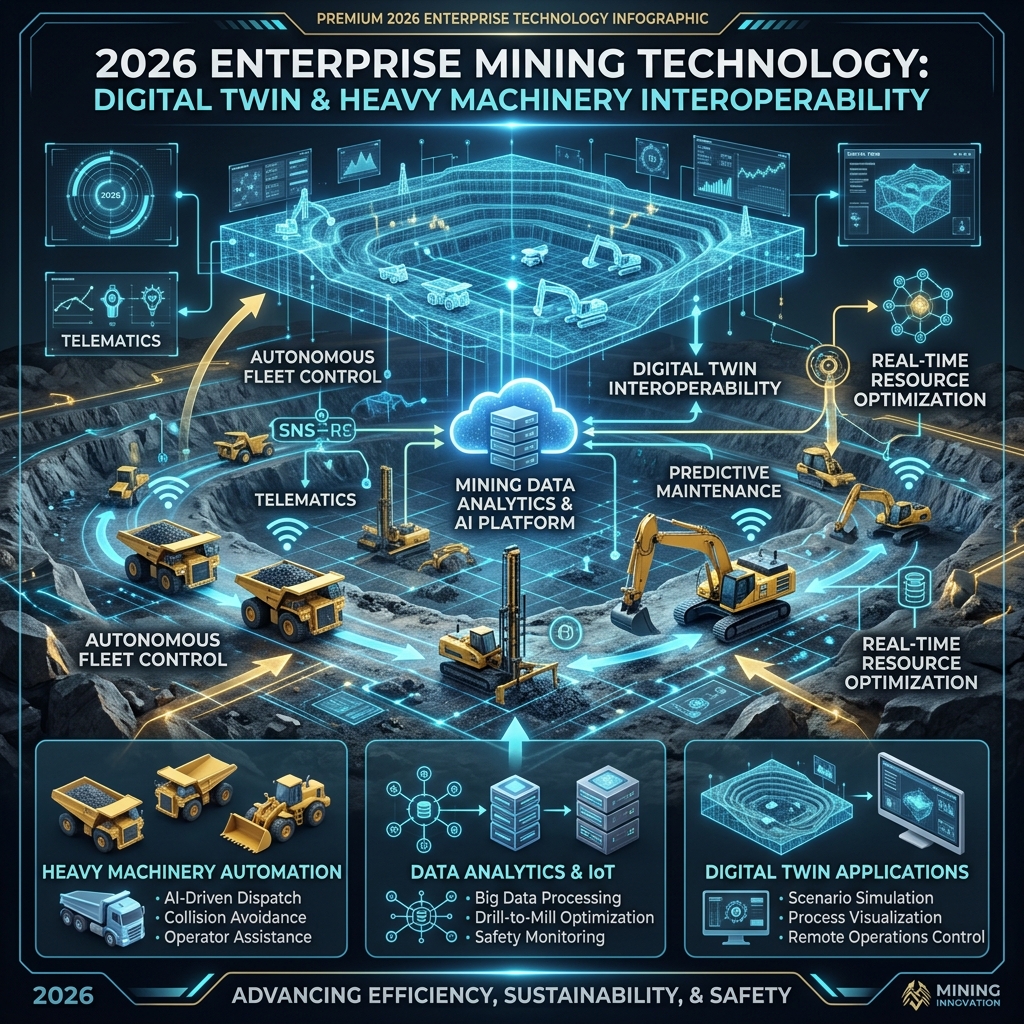
Mining and Heavy Industry: A Real Consortium, Narrowly Scoped to Interoperability
Mining does have a sector-specific open-source push it's simply narrower in scope and later-forming than pharma's pharmaverse or telecom's LF Networking, and it targets a different problem: not statistical methodology or network control, but the sheer cost of proprietary data lock-in across competing mine-planning software.
The Global Mining Guidelines Group (GMG) an industry-wide, vendor-and-operator consortium developed the Open Mining Format (OMF), an open-source specification for exchanging 3D geological and block-model data between otherwise incompatible software platforms. Four of the sector's major mine-planning software vendors Seequent, Dassault Systèmes, Deswik, and Micromine have publicly committed to supporting OMF.
What this consortium activity does not extend to is the operational and safety-critical layer: fleet automation, SCADA, autonomous-haulage control. Those systems remain on proprietary, contractually accountable vendor platforms.
The Common Thread
Across all five sectors, the depth of open-source adoption tracks a single underlying variable: how directly the open-source layer touches the thing the regulator or the balance sheet actually cares about.
| Sector | Consortium / governance body | What has gone open source | What has stayed proprietary |
|---|---|---|---|
| Pharma | pharmaverse, R Consortium, R Validation Hub | Statistical/reporting tooling (R packages), select FDA submissions | Core drug discovery IP, most trial execution systems |
| Banking | FINOS (Linux Foundation) | Regulatory reporting (CDM/DRR), AI governance/controls frameworks | Proprietary trading algorithms, core ledgers |
| Telecom | LF Networking, CNCF, O-RAN Alliance | Network orchestration, virtualization, RAN software the control plane itself | Physical infrastructure, some vendor silicon/hardware |
| Insurance | CAS (GitHub), OasisLMF | Actuarial modeling libraries, catastrophe-modeling frameworks | Core policy administration and claims systems |
| Mining | Global Mining Guidelines Group (GMG), Open Group / OSDU-for-Mining | Data interoperability format (OMF), cross-vendor data platform | Fleet automation, SCADA, safety-critical OT systems |
Four structural forces recur:
- 1. A neutral-to-permissive regulatory posture, rather than a mandate. The FDA's software-agnostic stance is the most explicit example; banking and telecom show the same pattern by absence no supervisory framework prohibits open-source infrastructure, and in telecom's case, standards bodies (3GPP, O-RAN) have actively coordinated with open-source foundations.
- 2. Consortium-based governance replacing single-vendor trust. pharmaverse/R Consortium, FINOS, LF Networking, CAS/OasisLMF which substitutes for the validation, support, and liability guarantees proprietary vendors historically provided. Mining's comparative lag is notable precisely because this layer doesn't yet exist for it.
- 3. Largest, most conservative incumbents moving first. Roche, GSK, Merck, Novo Nordisk (pharma); JPMorgan, Morgan Stanley, Citi, Goldman Sachs (banking); AT&T, China Mobile, Deutsche Telekom (telecom). Scale reduces the marginal risk of being an early open-source adopter and gives these firms outsized influence over the resulting standards.
- 4. Coexistence, not replacement, as the near-term operating model everywhere. SAS/R run in parallel at Novo Nordisk; banks open-sourcing regulatory reporting while keeping trading infrastructure proprietary; miners open-sourcing the data pipeline while keeping fleet-automation and safety systems on vendor platforms. The boundary of what gets open-sourced consistently falls just short of the system whose failure carries the highest direct liability.